|
|
联合国千禧年计划
 |
 |
目标 2 |
 |
|
普及初等教育
|
|
|
While some kids complain about doing homework and going to school, many children only wish they could learn how to read, write and do arithmetic. Goal 2 has one specific target: Ensure that, by 2015, children everywhere, boys and girls alike, will be able to complete a full course of primary schooling.
Many young people have to work in order to support their family instead of going to school, and in some families, girls are expected to stay home and help with the chores – a trend that forces girl children to forgo their own education. 115 million children do not attend primary school or do not complete their primary education. The three regions that experience the highest levels are: sub-Saharan Africa, South Asia and Middle East and North Africa. 133 million young people cannot read or write and only 37 of 155 developing countries have achieved universal primary school completion.
|
 |
|
 |
|
 |
只和
你的声音
|
如何影响青年
|
|
|
Education is crucial for youth and development. It creates opportunities and choices for youth, forms a path that leads away from poverty and diseases, gives youth a stronger voice in society, and opens doors to success.
Many young people are actively working to bring primary education to disadvantaged children, because young people from poor social situations want to see their younger peers get the education they had. Youth make excellent peer educators, teachers, and mentors since they have the knowledge, the experience and the interest in helping younger students with their studies and various life challenges. The way of the future is to supplement primary education with learning through Information and Communication Technologies (ICTs). The possibilities for learning are endless when young people have access to the Internet.
你怎样获得相关信息?
浏览我们的页以获得对你有益的建议
想知道更多关于Goal 2请访问
千年青年活动
千年活动
世界银行
« 返回上一级菜单 | 下一个 »
|
|
 |
|
|
| 需要做什么 |
|
| |
|
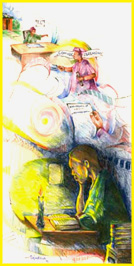
Tajudeen (尼日利亚)
|
The obvious answer is for governments to increase funding to primary education, but even when funding increases, there is often no equitable distribution of funds. In most poor countries, the poorest 20% of the population receives less than 20% of the public spending on education while the richest 20% get a higher share of government funds. Primary education also receives much less financing per student than secondary or higher education, which ends up discriminating against poor people. To achieve Goal 2, countries must increase funding to education and distribute it equitably.
Equally important is for countries to enroll all school-age children, and establish strategies that keep them in school. Additionally, school fees and uniforms should be eliminated, schools need be located closer to housing, hours should be scheduled to accommodate household chores, and morefemale teachers should be recruited. |
|
 |